
Having arrived at week 2, I have realised I really need to get going with what my photographic practice will consist of during this module.
I have so far used my photographic practice to explore London’s bridges, London buildings that have particular significances for participating people, and my own home. My work revolves around space, place, architecture and personal connections. I have worked in a number of styles including HDR landscapes, deadpan architecture, and more evocative black and white work. My techniques have evolved, becoming more and more analogue as the modules have gone on.
The more personal the work has become, the more stimulating and engaging I have found it both from my own point of view and in terms of the reactions viewers have.
Creatively, I feel the work I was doing in the previous module came to a natural end. I completed a short book of the work and was happy that the final edit of the images fulfilled the messages I wanted to convey.
During the break I did not feel very inspired in terms of photography. I had been away whilst completing the assignments of the previous module, and needed a real rest, alongside a sudden upsurge in other work.
Which leaves me entering this module with no recent (last few weeks) work aside from personal travel photography, and no one definitive idea for this module. I have a few options, so will spend a few weeks trying each out and seeing what works.
Possibility 1: Mini Me (needs a real title)
This idea has come out of personal reflection on body and space, particularly within buildings and around other people. As a larger and taller woman, who is also clumsy, I find I often feel physically awkward in different spaces. I have always felt like this, though it gets exacerbated when in countries with a shorter average height or when in crowded places, especially transport. I considered how to photograph this feeling of awkwardness, but then thought that rather than using photography to show how I feel I could use it more as a form of therapy. I could use photography to make myself feel as though I fit, or I could go to the extreme and experience life as a very (very) small version of myself.
I decided to combine this with an idea that fell by the wayside in the previous module – photographing objects within my home.
Inspired by miniature photography, and wishing to follow my current analogue trend, I chose to photography myself, print a small version, cut it out, and position it alongside an object. Then to photograph it using my previously used set up of direct positive paper in a polaroid back of a medium format camera. I did this because I wanted to be physically involved in this whole process that could so easily have been done digitally.
I had seen something similar by Chinese artist Shaoxiong Chen, who creates installations by photographing and then cutting out people and objects.
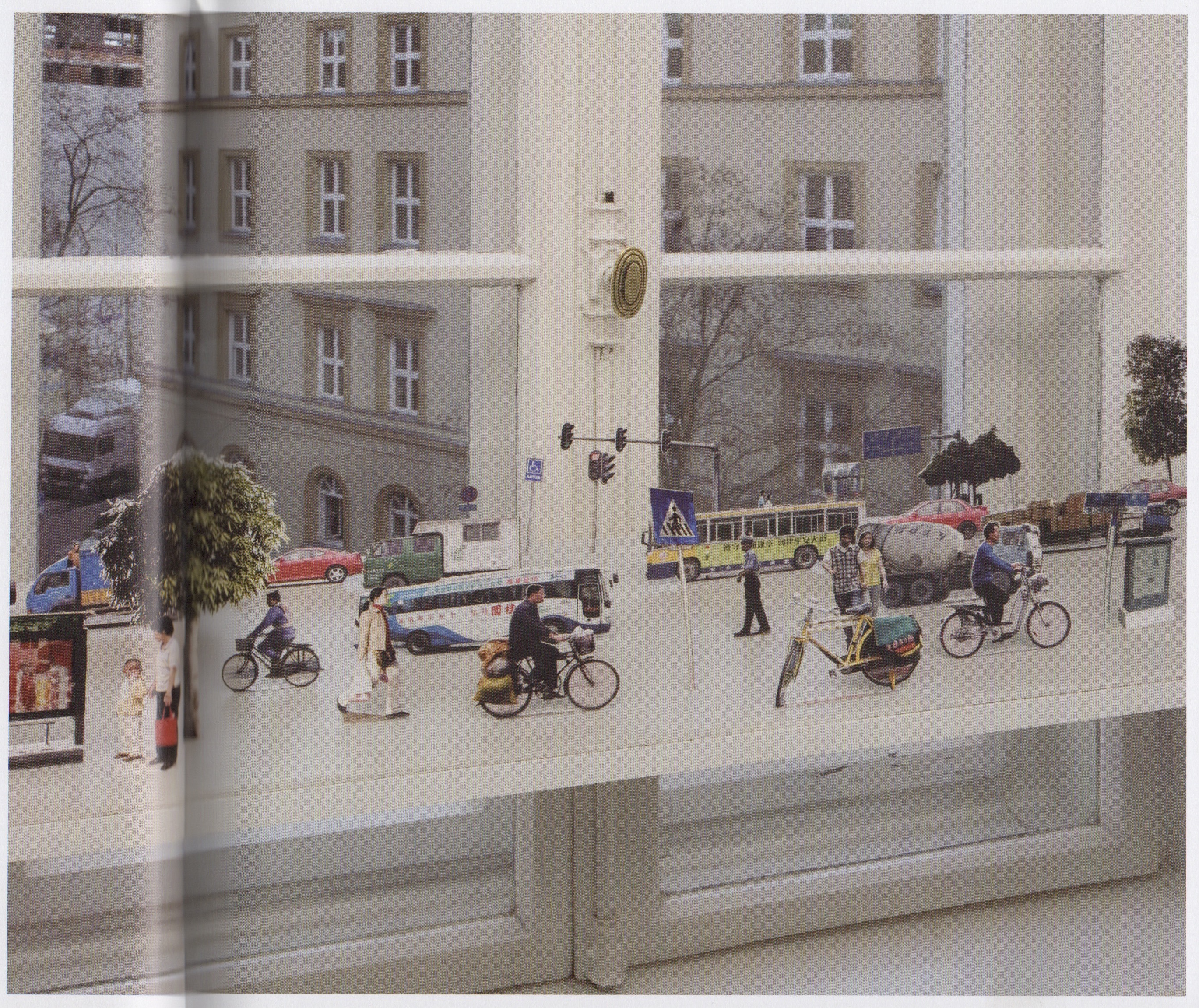
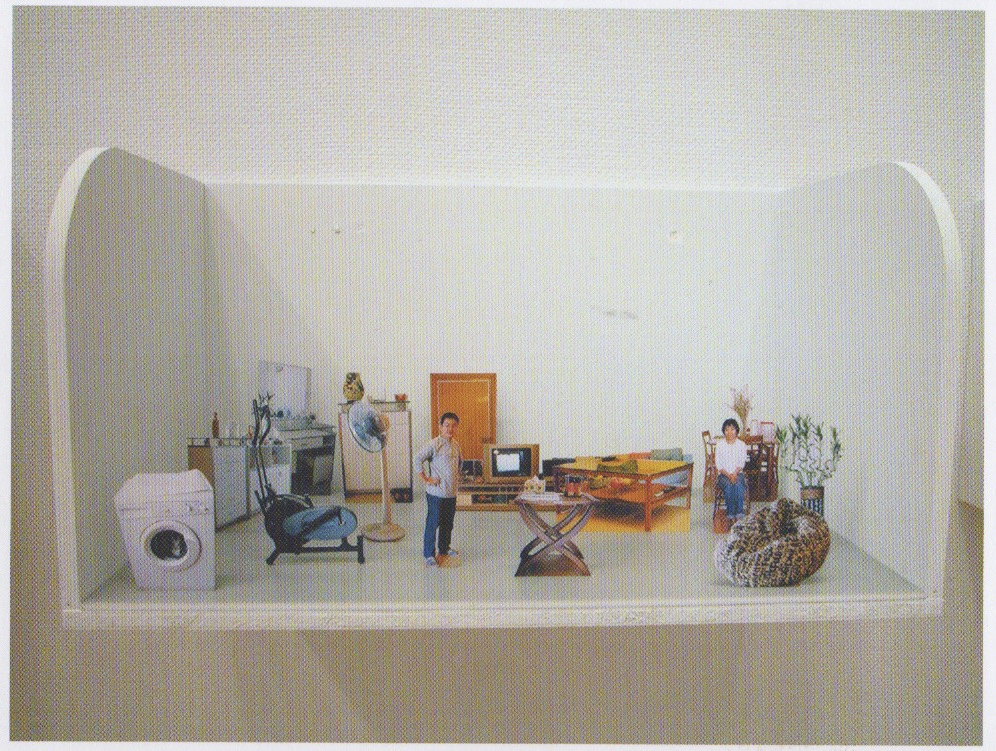
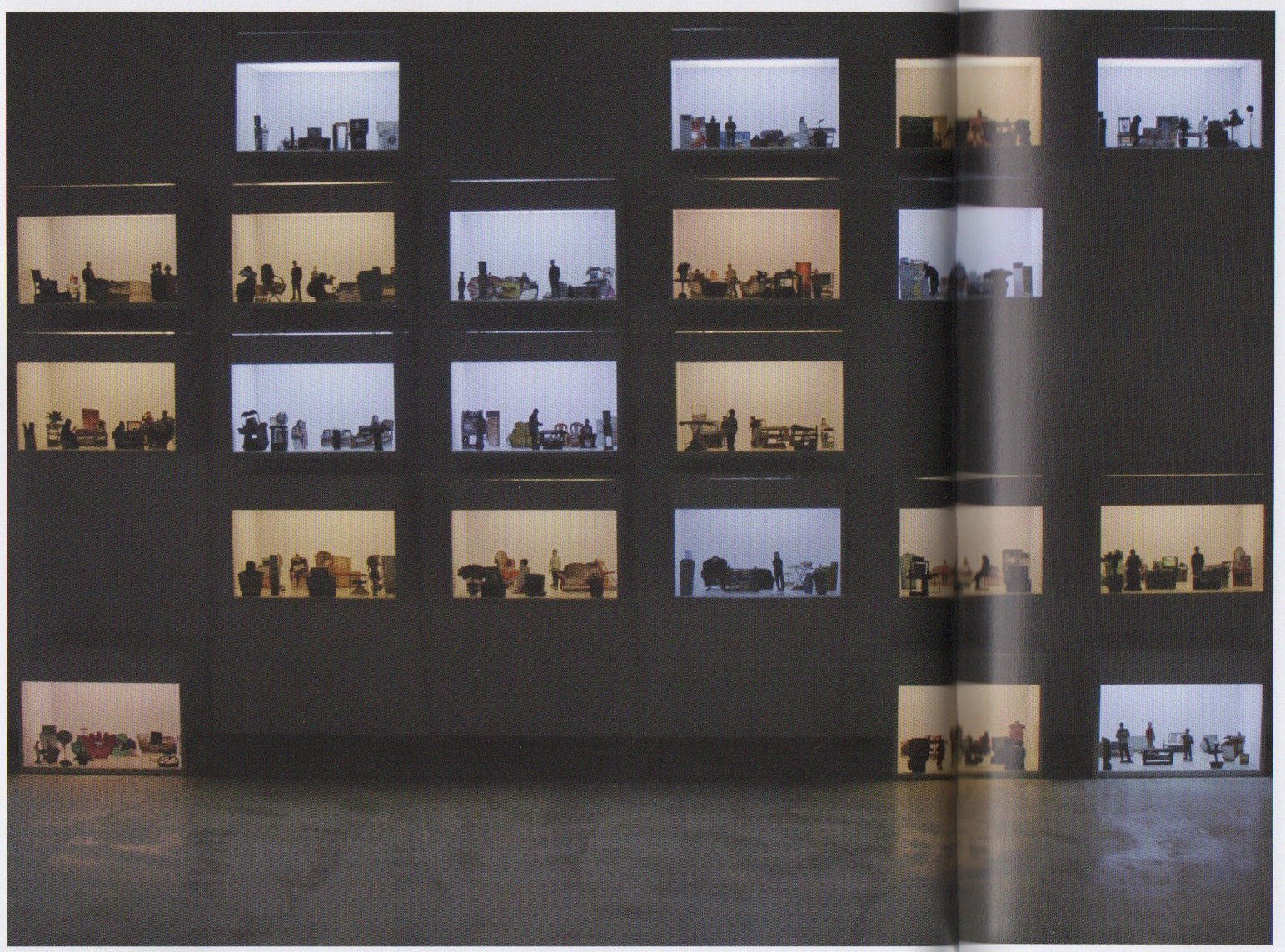
Streetscape (2005), Homescape (2005) & Homescape (2002) by Shaoxiong Chen
Chen says of his work, “When walking the streets, I see a great number of people and when you see so many people there, you realise how small you are. That is where my inspiration comes from.” (Dessanay and Valli 2011, p.32) His inspiration comes almost from the opposite angle mine does, it begins with feeling small. The difference is he scales down everything around his smaller people too, giving the viewer the feeling of being big, rather than the subject.
The cut out nature of his work gives it a real sense of an artist trying to make sense of the world, an artist manipulating shape and form to allow objects to interact in different ways. You can see the artists hand at work, and the 3D nature of the installation allows you to experience this world from multiple angles. There is something of the model town to this work, and the viewer could almost begin to consider either the artist or themselves as a form of god overlooking this world.
Another artist who works by cutting out miniature photographs, this time to create sculptures, is Akiko Ikeda. Her work consists of cutting out people and objects from photographs, magazines and books but leaving the feet attached, then popping them up so that the stand up out of the photograph, magazine or book. The works are then arranged in galleries in different ways that encourage visitors to view them from many angles. She again seems to work on the idea of the scale difference between the viewer and the work, rather than within the work as such. Ikeda says of her work, “…Miniatures have the power to draw you into their world, allowing you to lose you sense of scale and to commute freely through various dimensions.”


Akiko Ikeda, Various exhibitions, 2000-2007
Some of this work would seem to me to skirt an interesting boundary in terms of copyright and appropriation, something we have been focussing on in our coursework this week. When it comes to the photographs, Ikeda uses images she has taken in the work, so there is no copyright issue. However, her later work involved magazine and books that she did not create or write. Ikeda cut and rearranged the magazines/books but did not alter the images themselves. Were this to land in the US courts as a copyright infringement case, I do not think the judges would be as lenient as they were to Richard Prince.
I find Ikeda’s work’s interest really depends, for me, on the way it has been set up. Some works have multiple cut outs from multiple sources interacting with one another (a golfer setting up to take a shot, an onlooker further away pointing towards the golf hole). I find these far more engaging than single magazine pages. There is one image above of an exhibition that had multiple photographs laid out almost recreating a city of sorts. This is the part I am most interested in, because of the way perspective and angle will change what you see and how things interact with each other. However, I think this work needs to be seen in person in order to be fully explored.
Both Chen and Ikeda work with the idea of producing sculptures and installations that are designed to be seen in situ. They both bear in mind the size of the miniatures and the viewers and consider this to be a key part of the artistic expression.
In my own miniature work, I am more focussed on the dimensional interplay between the miniature me and the objects I am with. This is more like the artists who work with miniature figures (such as train figures) like Akiko Ida & Pierre Javelle, and Audrey Heller.


However, both of these works take a normal object and use it in a different way or to represent something else. I want to take objects that are important to me and examine them as they are.
Here are the results of my first try:


I’m happy with them aesthetically, and I feel they begin to work towards the idea of exploring size and space. I asked some colleagues for feedback, and they felt the images veered a little towards the cliche, but that the octopus one was the most successful. This is potentially because the object is not as obvious but also there is more physical interaction with it.
I think there is some room to work with these images, and I could move from analogue work to digital in order to use a macro lens to focus in and obscure the objects more, making the whole image less obvious and requiring more interrogation from a viewer. I am concerned that this would defeat the purpose of examining size and object, but it may also heighten it by getting very close in to the objects.
References:
- DESSANAY, MARGHERITA and MARC VALLI. 2011. Microworlds. London: King.
Images
- CHEN, SHAOXIONG. 2002. Homescape [Installation with photo-cut collage].
- CHEN, SHAOXIONG. 2005. Homescape [Installation with photo-cut collage].
- CHEN, SHAOXIONG. 2005. Streetscape [Installation with photo-cut collage].
- HELLER, AUDREY. 2011. What You Sow [image]. Available at: http://www.maxitendance.com/2012/01/photographies-visual-petits-fours-audrey-heller.html [accessed 8 October 2018].
- IDA, AKIKO and PIERRE JAVELLE. 2002. La Mine [image]. Available at: http://minimiam.com/ [accessed 8 October 2018].
- IKEDA, AKIKO. Date unknown. Variou. 2018. “AKIKO IKEDA : their site/your sight(since 2000)”. Ikedaakiko.net [online]. Available at: http://ikedaakiko.net/en/ty-sight.html [accessed 8 October 2018].

 Jo Salomon CRJ